
Successful Goal Setting
Eben Pagan challenges conventional goal-setting wisdom, revealing why traditional goal-setting fails for most people. He explains that success comes from setting up the right combination of elements systematically, rather than relying solely on individual goals.
Key Moments
How to Move Beyond Goal Setting to Systematic Success -- A framework for creating lasting success through systematic combination rather than individual goal achievement
Goals Still Matter — They're Just One Piece of the Puzzle
No, goals are still important as one piece of success. Reading books like Think and Grow Rich is valuable for developing goal-setting skills, but it's not the only road to success.
▶ 6:15
Goal Setting Fails Because Most People Don't Enjoy the Process
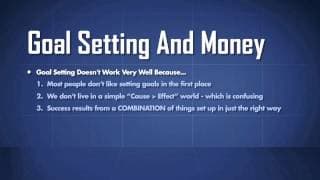
Goal setting doesn't work well for most people because they fundamentally don't enjoy the process of setting goals
▶ 0:31
Why Wealthy People Rely on Referrals
Success results from a combination of things set up in just the right way, like ingredients in a recipe
▶ 6:40
The Right Combination and Order Behind Successful Goal Setting
Instead of just setting goals, focus on knowing which things to set up in combination and in which order, like baking a cake with specific ingredients in a specific sequence.
▶ 6:36
We Don't Live in a Simple Cause-and-Effect World
We don't live in a simple cause-and-effect world where one action produces one result
▶ 1:46
Relevant Clips15
- How-To
How to Move Beyond Goal Setting to Systematic Success -- A framework for creating lasting success through systematic combination rather than individual goal achievement
- Teaching
Why the Brain Struggles With Multi-Cause Reality
The brain naturally wants simple cause-and-effect relationships where one action creates one result, but reality involves multiple interconnected causes and effects, creating confusion and frustration.
- Teaching▶ 0:24
Why Goal Setting Fails — Multiple Elements Must Work Together
Goal setting doesn't work because most people don't enjoy setting goals, we don't live in a simple cause-and-effect world, and success requires multiple elements working together systematically.
- Teaching▶ 6:15
Goals Still Matter — They're Just One Piece of the Puzzle
No, goals are still important as one piece of success. Reading books like Think and Grow Rich is valuable for developing goal-setting skills, but it's not the only road to success.
- Teaching▶ 5:49
How Successful People Set Up Systems Instead of Individual Goals
Successful people systematically set up various things in their life that all work together in concert, creating a combination approach rather than focusing on individual goals.
- Teaching▶ 6:36
The Right Combination and Order Behind Successful Goal Setting
Instead of just setting goals, focus on knowing which things to set up in combination and in which order, like baking a cake with specific ingredients in a specific sequence.
- Teaching▶ 2:49
Why the Human Mind Struggles With Complex Cause and Effect
The human mind is naturally predisposed to look for simple cause-and-effect relationships, which creates confusion when reality is more complex
- Teaching▶ 0:31
Goal Setting Fails Because Most People Don't Enjoy the Process
Goal setting doesn't work well for most people because they fundamentally don't enjoy the process of setting goals
- Teaching▶ 6:40
Why Wealthy People Rely on Referrals
Success results from a combination of things set up in just the right way, like ingredients in a recipe
- Teaching▶ 6:51
Making Money Requires Specific Ingredients in Specific Order
Making money requires specific ingredients combined in a specific order, just like baking a cake
- Teaching▶ 1:46
We Don't Live in a Simple Cause-and-Effect World
We don't live in a simple cause-and-effect world where one action produces one result
- Quotable▶ 6:51
Making Money Requires the Right Ingredients in the Right Order
just like baking a cake requires specific ingredients combined in a specific order making money is the result of the right combination
Show 3 more
- Quotable▶ 5:08
Success Comes From the Right Combination of Things
success results from a combination of things set up in just the right way
- Quotable▶ 1:48
Reality Is Not a Simple Cause-Effect World
we don't live in a simple cause effect world
- Quotable▶ 6:10
Goal Setting Doesn't Work Very Well
goal setting doesn't work very well
Entities Touched
Concepts
Questions
Canonical Teachings
Summary
The Three Fatal Flaws of Traditional Goal Setting
Eben reveals why goal-setting fails most people, starting with the fundamental mismatch between goal-setting and natural human motivation. Most people prefer solving problems over setting goals, creating internal resistance from the start.
The Complexity Problem: Why Our Brains Deceive Us
The human mind craves simple cause-and-effect relationships, but reality operates through complex interconnected systems. This cognitive mismatch creates frustration and confusion when traditional goal-setting approaches meet real-world complexity.
The Success Recipe: Systematic Combination Over Individual Goals
Eben introduces the alternative approach based on his observation of consistently successful people. Like baking a cake, success requires the right ingredients combined in the right order, working together systematically rather than pursuing isolated objectives.
Counterpoint
Claim: “Setting goals is the primary path to success and everyone should do it”
Reframe: Most people don't like setting goals and are more motivated by solving problems, so forcing goal-setting creates cognitive dissonance
In large live training seminars, only a few people raise their hands when asked who likes setting goals, while most prefer solving problems. Bob Beal's research confirms this in his book about problem-solving versus goal-setting
Claim: “Success comes from achieving individual goals through simple cause-and-effect thinking”
Reframe: Success comes from setting up the right combination of elements systematically, understanding that everything has multiple interconnected causes and effects
Every consistently successful person Eben has met has systematically set up various things that work together in concert, not just achieved individual goals
Related Content

Eben Pagan | The Inner Work of Scaling a Business - YouTube
The world's most unlikely dating guru reveals why your biggest weakness could become your most profitable business opportunity.

You Only Need ONE Good Way To Get New Clients (Try THIS!)
The sales approach that took Eben Pagan from phone anxiety to landing a $12,000/month client in just one meeting.
Learning Learn
Discover why traditional learning fails entrepreneurs and how to transform your brain into a self-building computer that adapts to any situation.
How To Make Your Success Inevitable
Discover why 80% of people fail at traditional goal-setting and how to use your primal drives to make success inevitable instead of constantly fighting against yourself.
Hacking Human Success
Discover why your mind is designed to prevent self-examination and learn the samurai warrior's secret to winning before the battle even begins.
Why You Should Think Meta To Create Success
Discover why successful entrepreneurs think in 'meta' levels and how success emerges from systems thinking rather than linear cause-and-effect strategies.
Topics
Business Frameworks
Common Mistakes