Teaching

How To Price Your Product Correctly

How To Price Your Product Correctly

Eben Pagan teaches a systematic framework for pricing products based on value translation and positioning. He demonstrates how to identify your prospect's unique currency, translate your product's value into their terms, and frame pricing to show 10x return on investment.

How To Price Your Product Correctly

0:00--:--
Listen:Website

Understanding Prospect Psychology in Pricing

Eben reveals the two unconscious questions every prospect asks about pricing and why humans need help connecting value across different realms. This psychological foundation explains why detailed value framing is essential rather than simply stating a price.

The Unique Currency Framework

The core concept of identifying each prospect's unique currency - their primary desired outcome that functions like money in their value system. Eben provides examples from weight loss and dating niches to illustrate how this works in practice.

Wake Up Productive Pricing Case Study

A detailed breakdown of Eben's actual sales copy showing how to calculate hourly value, use conservative estimates for credibility, and translate time savings into compelling dollar amounts. The example demonstrates how a $497 product delivers $6,000+ annual value.

Advanced Positioning and Payment Strategies

Techniques for leveraging live training prices to position digital products as exceptional value, plus the psychology of payment plans to remove financial objections and increase conversion rates.

Questions This Episode Answers

How do I price my product to show clear value to prospects?

Your offer when you're pricing your product or service is at least three times and ideally 10 times or more what you're asking them to spend or invest.

Eben Pagan4:21

First identify your prospect's unique currency - what they're really trying to accomplish. Then translate your product's benefits into their terms and connect it to dollar values. Show at least 10x return on investment using conservative estimates.

What is the unique currency concept in pricing?

What is their unique currency? Or what is the coin of your prospect's realm? In other words, what is the thing that they're trying to accomplish and how can you consider it almost like a currency or almost like money in a certain sense?

Eben Pagan2:19

Unique currency is the coin of your prospect's realm - the thing they're trying to accomplish that functions like money in their value system. For weight loss, it might be pounds of fat. For dating coaching, it could be number of dates or avoiding rejection.

Should I use my biggest claims when presenting pricing?

Next, let's assume that the Wake Up Productive program does not perform for you as well as I'm promising. In other words, let's be quote realistic or quote conservative about it.

Eben Pagan12:30

No, use conservative estimates instead. Back off from your biggest promises to build credibility. Show value even in worst-case scenarios. This makes you more trustworthy while still demonstrating clear return on investment.

How do I calculate hourly value for pricing presentations?

The simple way to calculate it is to take your yearly income, then divide in half and remove three zeros. If you make $100,000 per year, you'd divide that in half and get 50,000, then remove three zeros and you get $50 per hour.

Eben Pagan5:51

Take yearly income, divide in half, and remove three zeros. So $100,000 becomes $50/hour, $50,000 becomes $25/hour. Use aspirational income numbers that prospects want to achieve, not just current income.

What questions do prospects ask themselves about pricing?

The questions that your prospect is unconsciously asking are, how can I know that this is worth a lot more than I'm paying for it? And can you prove the result you're promising?

Eben Pagan0:31

Prospects unconsciously ask two key questions: 'How can I know that this is worth a lot more than I'm paying for it?' and 'Can you prove the result you're promising?' Your pricing presentation must answer both questions clearly.

How do I frame digital product pricing compared to live training?

If I was offering this as a live training, I would charge at least $2,000 for it, probably more. But because I can offer this program to you in an online home study format, I'm going to make this program available to you at a price that's ridiculously low.

Eben Pagan16:03

Reference what you would charge for live training, then position your digital product as a bargain. For example, 'If this was live training, I'd charge $2,000, but because it's digital, I can offer it for much less.'

How to Price Your Product Using Value Translation

A systematic approach to pricing products that demonstrates 10x value to prospects

  1. 1

    Identify Unique Currency

    Determine your prospect's unique currency - the thing they're trying to accomplish that functions like money in their value system

  2. 2

    Calculate Hourly Value

    Use yearly income divided by half with three zeros removed. Start with aspirational income numbers prospects want to achieve

  3. 3

    Use Conservative Estimates

    Back off from maximum promises and show value in worst-case scenarios to build credibility

  4. 4

    Break Down Time Value

    Calculate daily, monthly, and yearly dollar values to make the math concrete and compelling

  5. 5

    Reference Live Training Prices

    Position digital products as bargains compared to what you'd charge for live training

  6. 6

    Offer Payment Plans

    Provide monthly payment options to remove financial objections and increase accessibility

All Teachings 10

TeachingEmpowering0:31

Prospects unconsciously ask two critical questions: 'How can I know this is worth a lot more than I'm paying?' and 'Can you prove the result you're promising?'

Eben identifies these as the foundational questions that must be answered in pricing presentations before introducing the actual price

TeachingEmpowering1:06

Humans are bad at putting value on things and translating value from one realm to another - they need someone to connect the dots and explain how the value works

Eben explains this as the psychological foundation for why detailed value framing is necessary rather than simply stating a price

TeachingEmpowering2:19

Identify your prospect's unique currency or 'coin of their realm' - the thing they're trying to accomplish that functions like money in their value system

Examples given include fat loss for weight loss products, number of dates for dating coaching, or avoiding rejection as the real currency

TeachingEmpowering4:21

Your offer should provide at least 3x and ideally 10x or more value than what you're asking prospects to invest

Eben states he doesn't like to sell anything unless convinced buyers can get at least 10x their investment back if they use it

TeachingEmpowering5:51

Calculate hourly value using yearly income divided by half, then remove three zeros - if you make $100,000 per year, you make about $50 per hour

Demonstrated in Wake Up Productive sales letter where $100,000 ÷ 2 = 50,000, remove three zeros = $50/hour; $50,000 becomes $25/hour

TeachingEmpowering11:12

Start with aspirational income numbers that prospects want to achieve, not just current income - $100,000 is a magic aspirational number for most people

Eben learned from interviews that $100,000 represents the six-figure range people think of as success, so he starts there before moving to average income of $40-50,000

TeachingEmpowering12:30

Use conservative estimates to build credibility - assume your product only delivers partial results rather than full promises

In Wake Up Productive, instead of claiming doubled productivity, Eben calculates value based on just one extra hour per day to stay realistic and trustworthy

TeachingEmpowering13:02

Break down time savings into daily, monthly, and yearly dollar values to make the math concrete and compelling

Example: 1 hour/day at $25/hour = $25/day = $500/month = $6,000/year, making a $497 investment clearly profitable

TeachingEmpowering16:03

Reference your live training prices to justify lower digital product pricing - 'If this was live training, I'd charge $2,000+'

Eben positions $497 digital product as bargain compared to $2,000 live training, leveraging credibility from his $10,000 high-end programs

TeachingEmpowering17:23

Offer payment plans to remove financial objections - 'three easy monthly payments of $177 each so you have literally no excuse'

Breaking $497 into $177 monthly payments addresses affordability concerns and increases conversion rates

Episode Tone
3 foundational5 intermediate2 advanced

Key Teachings 10

Prospects unconsciously ask two critical questions: 'How can I know this is worth a lot more than I'm paying?' and 'Can you prove the result you're promising?'

0:31

Humans are bad at putting value on things and translating value from one realm to another - they need someone to connect the dots and explain how the value works

1:06

Identify your prospect's unique currency or 'coin of their realm' - the thing they're trying to accomplish that functions like money in their value system

2:19

Your offer should provide at least 3x and ideally 10x or more value than what you're asking prospects to invest

4:21

Calculate hourly value using yearly income divided by half, then remove three zeros - if you make $100,000 per year, you make about $50 per hour

5:51

Start with aspirational income numbers that prospects want to achieve, not just current income - $100,000 is a magic aspirational number for most people

11:12

Use conservative estimates to build credibility - assume your product only delivers partial results rather than full promises

12:30

Break down time savings into daily, monthly, and yearly dollar values to make the math concrete and compelling

13:02

Reference your live training prices to justify lower digital product pricing - 'If this was live training, I'd charge $2,000+'

16:03

Offer payment plans to remove financial objections - 'three easy monthly payments of $177 each so you have literally no excuse'

17:23

Counterpoint 2

Claim:Just state your price and let customers figure out if it's worth it

Reframe: You must actively frame and translate value because humans are bad at determining worth across different realms

Claim:Use your biggest, most impressive claims to justify your pricing

Reframe: Use conservative estimates and worst-case scenarios to build credibility and trust

Quotable Moments

I don't like to sell something unless I'm convinced that if a person buys it and uses it that they can get at least 10 times their investment back.

Eben Pagan4:21

We humans are really not very good at putting value on things. We're also bad at translating value kind of from one realm to another. We need someone to connect the dots for us.

Eben Pagan1:06

What you want to do is you want to set up the value proposition and really frame the price so it's positioned as being much, much more valuable than the price that you're charging for the product.

Eben Pagan1:46

You Might Be Interested In

Use "negative capability" to shut down your own biases and simulate someone else's emotional state to understand their true motivations

Concept from poet Keats, learned from Ned Hallowell (author of 'Crazy Busy') who was introduced by Joe Polish. Allows entrepreneurs to experience emotions from customer's perspective.

Create "alternate currency" by translating customer's emotional pain into monetary value that can be communicated in real-world terms

Example: Hip replacement patient willing to pay $1000 to eliminate pain, $100 per 10% pain reduction. Product costing $97 that eliminates most pain becomes no-brainer when framed against $1000/month lost income.

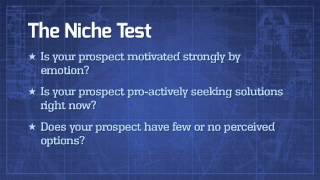
Use a three-question niche test to evaluate any new business opportunity or product idea

Eben Pagan developed this framework through building his multi-million dollar virtual business and applies it to both new niches and products, which he considers sub-niches

Your prospects must be motivated strongly by emotion - fear, desire, passion, or worry - for your niche to be profitable

Eben demonstrates this with the retirement savings example, showing that people aren't emotionally motivated to save for retirement but are strongly motivated to get out of $20,000-50,000 credit card debt